
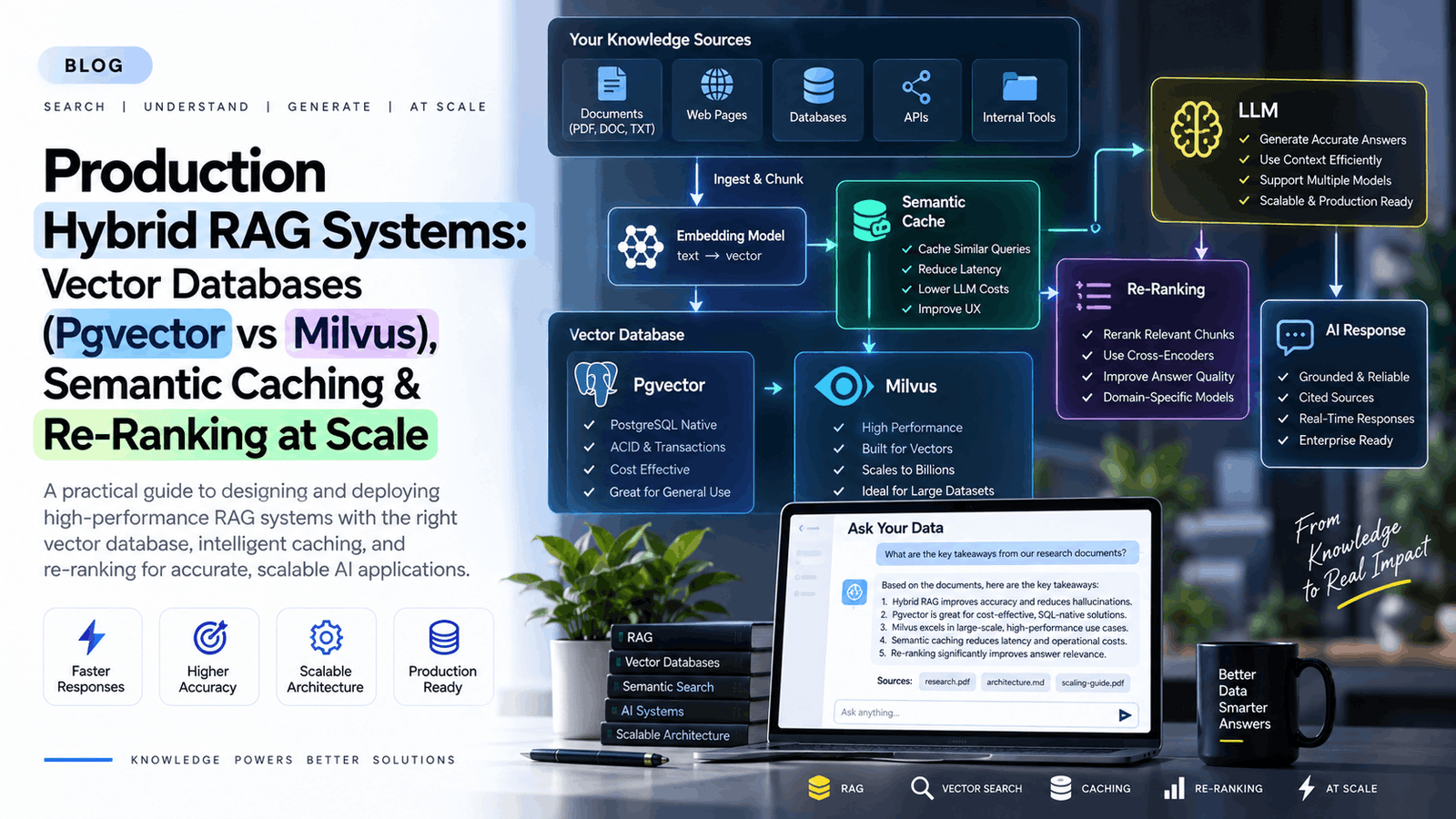
1. The Reality of Production RAG in 2026
While naive Retrieval-Augmented Generation (RAG) tutorials rely on simple cosine similarity searches against small local vector stores, production enterprise applications immediately face latency bottlenecks, hallucination, and poor context precision. When searching millions of document chunks across diverse enterprise domains, basic semantic search retrieves semantically similar but factually irrelevant data.
At Techifiles Technologies, we architect Production Hybrid RAG Systems combining dense semantic vector embeddings, sparse lexical retrieval (BM25), cross-encoder re-ranking, and high-speed semantic caching to deliver sub-80ms retrieval latencies with 94%+ answer accuracy.
2. Vector Database Architecture: Pgvector vs. Milvus 2.4
Choosing the right vector database is the foundation of high-scale semantic retrieval:
| Feature | Pgvector (PostgreSQL 17) | Milvus 2.4 (Distributed) |
|---|---|---|
| Optimal Scale | Under 5 Million Vectors | 10 Million to Billions of Vectors |
| Index Types | HNSW, IVFFlat | HNSW, SCaNN, DiskANN, GPU IVF |
| Operational Overhead | Zero (Existing Postgres DB) | Requires Kubernetes / Distributed Cluster |
| Hybrid Search | Postgres Full-Text + Vector | Native Dense + Sparse Multi-Vector |
3. Hybrid Search: Fusing Dense Semantic Vectors & Sparse BM25
Semantic embeddings (e.g., text-embedding-3-large or bge-large-en-v1.5) excel at broad concepts, but struggle with precise keywords, part numbers, exact acronyms, and alphanumeric identifiers. Sparse lexical search (BM25) excels at exact matches but fails at conceptual synonyms.
We combine both approaches using Reciprocal Rank Fusion (RRF):
# rrf_fusion.py
def reciprocal_rank_fusion(dense_results, sparse_results, k=60):
    scores = {}
    for rank, doc_id in enumerate(dense_results):
        scores[doc_id] = scores.get(doc_id, 0.0) + 1.0 / (k + rank + 1)
    for rank, doc_id in enumerate(sparse_results):
        scores[doc_id] = scores.get(doc_id, 0.0) + 1.0 / (k + rank + 1)

    # Sort documents by fused score
    sorted_docs = sorted(scores.items(), key=lambda item: item[1], reverse=True)
    return [doc_id for doc_id, score in sorted_docs]
4. Two-Stage Cross-Encoder Re-Ranking Pipeline
Bi-encoders (embedding models) compute vector representations independently, enabling fast nearest-neighbor search. However, they cannot model dynamic cross-attention between question tokens and document tokens. A production pipeline implements a two-stage retrieval:
- Stage 1 (Coarse Retrieval): Retrieve Top-50 candidates via Hybrid Search in <20ms.
- Stage 2 (Cross-Encoder Re-Ranking): Pass the Top-50 candidates through a lightweight cross-encoder model (e.g.,
bge-reranker-largeor Cohere Rerank 3) to score full token interactions and prune down to the Top-5 highest precision chunks.
5. Semantic Caching via Redis 7: Slashing LLM Token Costs
Over 35% of enterprise queries are semantic variants of previously asked questions (e.g., "How do I setup SSO?" vs. "SSO configuration steps"). By computing the embedding of incoming user prompts and performing vector similarity search against a Redis 7 vector cache, recurring queries return in <8ms with zero LLM API cost.