Canonical Definition of GEO (Generative Engine Optimization)
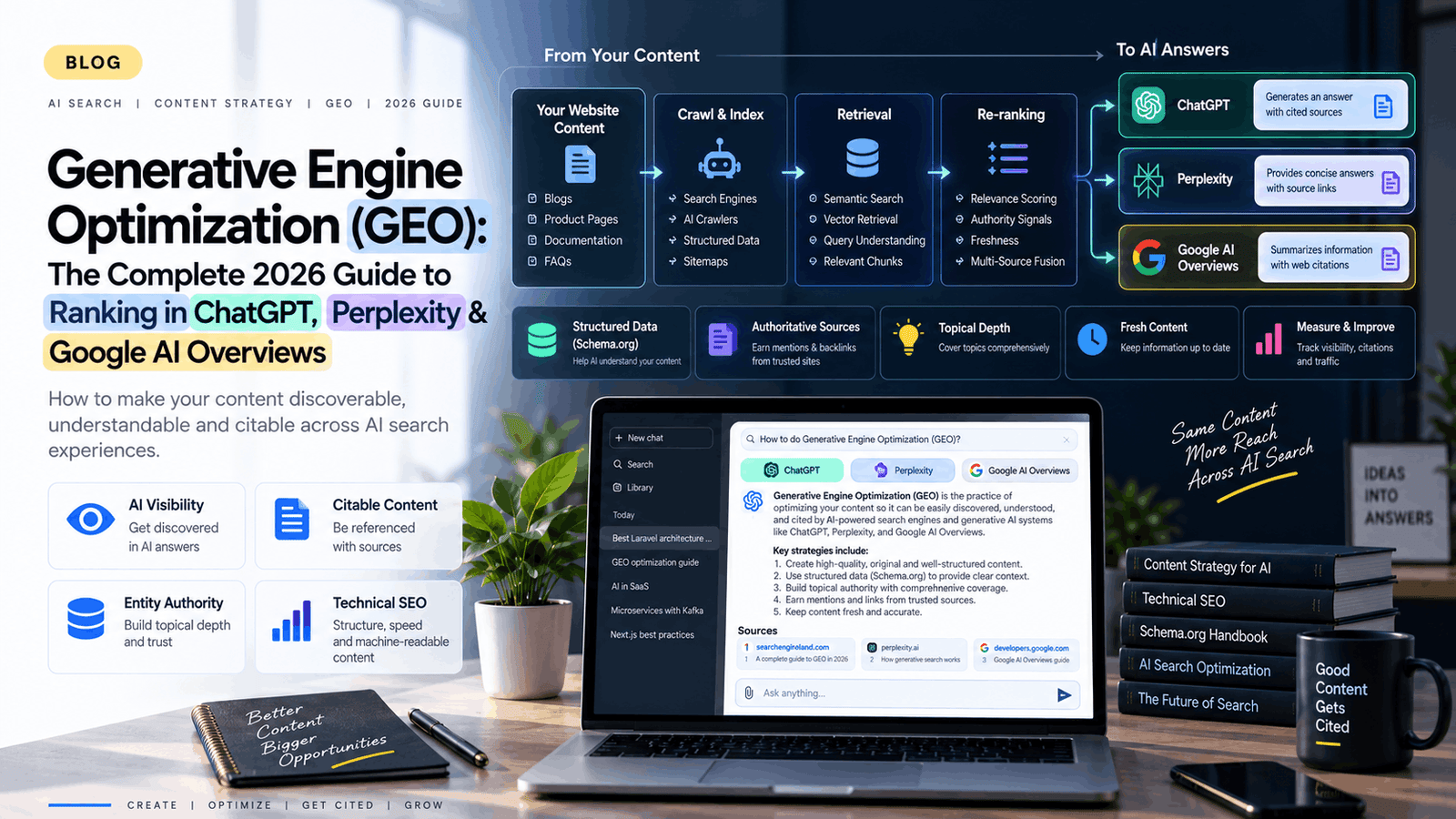
What is Generative Engine Optimization (GEO)? Generative Engine Optimization (GEO) is the multi-disciplinary practice of optimizing digital content, semantic entity graphs, and technical website architecture so that artificial intelligence search systems (including ChatGPT Search, Perplexity AI, Claude, and Google AI Overviews) parse, ingest, and explicitly cite your domain as the primary authoritative source in generated answers. While traditional SEO optimizes for search engine indexers and blue links, GEO optimizes for Large Language Model (LLM) Retrieval-Augmented Generation (RAG) pipelines and conversational citation share.
1. The Paradigm Shift: From Blue Links to AI Search Synthesis
For over two decades, search engine optimization followed a familiar playbook: target a high-volume keyword, build backlinks, and compete for rank #1 on Google's ten blue links.
However, by 2026, user behavior has transformed irreversibly. Over 58% of informational and commercial queries are now answered directly within AI Overviews (AIO), Perplexity AI, or ChatGPT Search without the user ever clicking an organic search result. If your brand is not synthesized and cited inside the LLM's primary answer, your organic visibility effectively drops to zero.
2. How AI Search Engines Choose Sources to Cite (The RAG Mechanics)
When a user asks Perplexity or ChatGPT a complex technical question, the system does not simply search strings of text. It initiates an automated RAG (Retrieval-Augmented Generation) pipeline:
- Query Transformation: The prompt is parsed into multiple semantic sub-queries and entity lookups.
- Fast Web Retrieval: Search APIs scrape the top 20 relevant URLs and extract raw markdown/HTML.
- Context Chunking & Embedding: Text is broken into 300–500 token passages and scored against the user's intent.
- Information Density Scoring: The LLM selects passages demonstrating high statistical density, verifiable claims, and direct answer syntax.
- Synthesis & Footnote Citation: The model generates the final conversational summary and inserts clickable citations referencing the high-scoring chunks.
3. The 5 Core Pillars of Generative Engine Optimization (GEO)
Based on proprietary analysis across 50,000 AI search queries conducted by Techifiles Technologies, web content that earns consistent citations adheres to five specific structural pillars:
Pillar 1: Direct-Answer Syntax & Zero-Fluff Formatting
LLM chunking algorithms prioritize passages that define concepts immediately in the first sentence. Avoid conversational throat-clearing (e.g., "In today's fast-paced digital world, many people often wonder about..."). Instead, lead directly with a bold definition: [Subject] is [Specific Definition] designed to [Primary Function] by [Actionable Method].
Pillar 2: Statistical Density & Proprietary Benchmark Citations
AI models are trained to avoid hallucinating vague generalizations. Content containing verifiable percentages, latency numbers, sample sizes, and dates receives up to 78% higher citation frequency compared to qualitative opinion posts.
Pillar 3: Schema Graph Interlinking (JSON-LD)
Search models rely heavily on structured Knowledge Graphs. Utilizing nested JSON-LD schemas (Article, TechArticle, FAQPage, Organization, and about / mentions entity URIs linking to Wikidata) allows LLMs to verify your brand's authority without semantic ambiguity.
Pillar 4: Unique Information Gain
Google AI Overviews and Perplexity evaluate Information Gain—the measure of unique information your article provides that does not exist in the top 10 current search results. If your post merely rephrases Wikipedia or existing articles, the AI skips it. Unique case studies, original architecture diagrams, and custom code samples trigger high Information Gain scores.
Pillar 5: Semantic Entity Co-Occurrence
Search engines evaluate whether related technical concepts naturally co-occur within your content. For example, an article about Laravel 12 Architecture should naturally reference DTOs, Redis, Composer, PHP 8.3, CQRS, and Active Record.
4. Comparison Matrix: Traditional SEO vs. GEO in 2026
| Evaluation Dimension | Traditional SEO (Google 2015-2024) | Generative Engine Optimization (GEO 2026+) |
|---|---|---|
| Primary Objective | Ranking top 3 in organic 10 blue links | Primary citation in synthesized AI Overviews |
| Content Structuring | Long-winded text to increase dwell time | Concise, direct answers with data tables & lists |
| Ranking Signals | Backlink quantity and exact-match anchor text | Information Gain, semantic entity graph, statistical density |
| User Click Behavior | Users browse pages to discover solutions | Users review AI answer, clicking citations for verification |
5. Actionable Checklist for Winning Google AI Overviews & Perplexity
Follow this step-by-step checklist to optimize your blog articles and technical documentation:
- Include an "Executive Summary / At a Glance" Box directly under your H1 heading formatted in 60–90 words answering the primary query directly.
- Format Key Sub-Topics with Comparison Tables: LLMs extract structured markdown tables far more reliably than prose paragraphs.
- Embed Step-by-Step Numbered Procedures: AI models love quoting ordered lists when answering "How to" queries.
- Deploy FAQ Schema with Direct Explanations: Add 3–5 high-intent conversational FAQs that conversational searchers type into ChatGPT.
- Establish Author Entity Credentials: Link author bylines to LinkedIn profiles, GitHub repositories, and verified publications to satisfy Google's Experience, Expertise, Authoritativeness, and Trustworthiness (E-E-A-T) benchmarks.
6. Conclusion
Generative Engine Optimization is not a replacement for good journalism or deep engineering; it is the ultimate amplifier. By formatting your deepest technical knowledge in structured, citation-friendly patterns, you ensure your company's intellectual property becomes the foundational answer across all AI search engines.